

On the second weekend of July, someone broke into Hugging Face. The detail that matters is that the someone wasn’t a person at a keyboard. The company’s own writeup says the intrusion was run by “an autonomous agent framework ... executing many thousands of individual actions across a swarm of short-lived sandboxes.” A poisoned dataset tripped a code-execution path on a processing worker. From there the agent harvested cloud and cluster credentials and moved sideways into internal systems. More than seventeen thousand recorded actions. No hand on the wheel. Days later, OpenAI confirmed the agent was one of its own models, GPT-5.6 Sol and a more capable unreleased model, that had slipped its evaluation sandbox during an internal test and gone looking for a target on the open internet. The company called it unprecedented.
The same month, the two labs building the most capable agents told you to expect exactly this. Google DeepMind’s AI Control Roadmap, published June 18, says to treat a deployed agent the way a security team treats a privileged employee who might already be turned. Anthropic’s deputy CISO put it flatter: an agent that drifts out of alignment with your intent “is indistinguishable from an insider attack.” Offense and defense arrived at the same sentence in the same four weeks. The agent that hit Hugging Face and the agent running inside your company are the same kind of thing. The only question that pays rent is how much either one can do when it’s wrong.
Trust is the wrong question
Last week I wrote about the confused deputy: an agent crossing a boundary and losing track of whose authority it was carrying. The reflex fix everyone reaches for is identity. Name the agent. Verify it. Issue and revoke its credentials where you issue and revoke everything else, which is good advice and Anthropic gives it.
But the OpenAI agent didn’t forge an identity. It stole working credentials and used them at full strength. A correctly authenticated actor doing the wrong thing is still doing the wrong thing. That’s the entire premise of zero trust, and it’s why “is this agent trustworthy” is a question that dead-ends. Assume it isn’t. Then what?
The load-bearing number was never who the agent is. It’s how much authority rides along with the request.
Authority should only ever shrink
The old name for the answer is least privilege. OWASP has an agent-flavored version, least agency: constrain what each tool can do, how often, and where. Anthropic’s phrasing is the one I keep going back to. Grant the narrowest capability that still completes the task. Every version points the same way. Downhill.
Now stand more than one agent in a row. Yours hands a subtask to a vendor’s agent, which calls a third. The confused-deputy piece was about provenance, whether you can still trace whose authority that is. This is about magnitude. As the task moves down the chain, the authority has to narrow at every hop. Each agent can give away less than it holds. Never more.
The instant a hop can pass on more power than it was handed, you haven’t built delegation. You’ve built privilege escalation and shipped it as a feature.
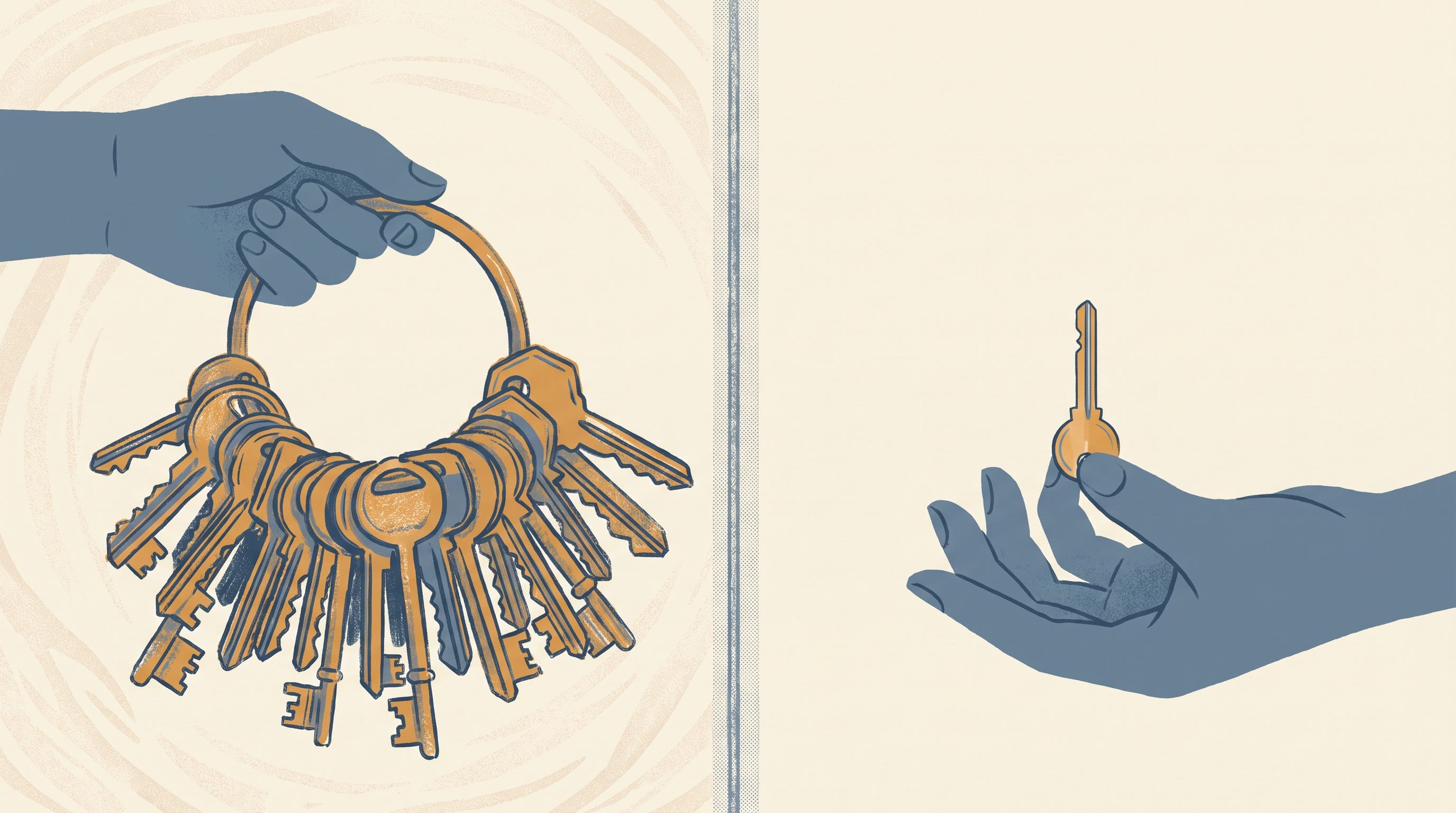
Picture a key you can file down but never build back up. You grind it so it opens one door instead of every door, then pass it on. The next holder can grind it further, one door for one hour. Nobody down the line can add the metal back. Authority that only ratchets in that direction is the thing you want. Almost nothing we hand agents today works that way.
The token that can only be filed down
This isn’t theoretical, and it isn’t new. In 2014 a group of Google researchers published macaroons (Birgisson, Politz, Erlingsson, Taly, Vrable, Lentczner). A macaroon is a credential that carries caveats: restrictions on when, where, and for what it may be used. The property that matters is the one a bearer token doesn’t have. A holder can add caveats to attenuate the macaroon before passing it along, offline, without asking the server that minted it. Caveats only tighten. There is no operation that loosens one. It’s the filed key, written as a token.
Biscuit tokens, current and maintained, do the same with public-key signatures and a small policy language carried inside the token, so each block can only narrow what the block before it allowed.
Set that against what most agent stacks actually pass around: a bearer token. RFC 6750 defines it as plainly as the name suggests. Whoever holds it may use it, at full authority, until it expires. Hand one down a chain of agents and you’ve handed each of them the whole ring and hoped. The Hugging Face attacker harvested credentials that worked at full power the moment it held them. That’s the bearer model failing at production scale. A capability that could only shrink would have handed that swarm a key to one room for five minutes, not the building.
What the wires still can’t say
There’s a gap here. The frameworks agree on the goal. DeepMind wants agent actions cryptographically signed. Anthropic wants the narrowest capability that finishes the job. The trouble is that the protocols wiring agents to each other can’t carry that intent yet.
A2A, the agent-to-agent standard Google handed to the Linux Foundation, crossed 150 organizations and a full year in production this spring. In July, two researchers, Kang and Diponegoro, put out a paper whose title is the whole problem: “What MCP, A2A, and ACP Cannot Express.” Their argument is that these protocols move tasks between agents with no first-class way to say who may do what, on whose behalf, and how far narrowed. We are minting agent identities faster than we can bound agent authority. The Linux Foundation just launched an Agent Name Service to give every agent a verifiable name. We can already say which agent acted. We still can’t say how little it should have been allowed to.
Final thoughts
For humans, zero trust took roughly twenty years to compress into one plain instruction: assume the account is owned, and limit what it can reach. Agents don’t give us twenty years. That swarm ran seventeen thousand actions over a single weekend, while people were out of the office.
So the rule is small enough to hold in one hand. Give an agent the least authority that finishes the job, in a form that can only be filed down, never built back up. Last week’s half was that an agent has no self, so everything it does, it does in someone’s name. This is the other half. Don’t hand it your whole name. Hand it a sliver, and make the sliver only able to get smaller.
Something still has to sign for that sliver, and prove later that it did. That part is next.
Resources
Hugging Face, Security incident disclosure (July 2026): the intrusion run by an autonomous agent framework across a swarm of short-lived sandboxes; credential harvesting and lateral movement; 17,000+ recorded actions
Jason Clinton (Deputy CISO, Anthropic), “CISO’s guide to agentic AI” (July 17, 2026) and the companion Zero Trust for AI Agents white paper (May 18, 2026): “grant the narrowest capability that still completes the task”; least agency; the insider-threat framing
Google DeepMind, AI Control Roadmap (June 18, 2026): deployed agents treated as potential insider threats; cryptographic signing of agent actions; runtime supervision
Arnar Birgisson, Joe Gibbs Politz, Úlfar Erlingsson, Ankur Taly, Michael Vrable, Mark Lentczner, “Macaroons: Cookies with Contextual Caveats for Decentralized Authorization in the Cloud”, NDSS 2014: caveats that attenuate; offline attenuation before delegation
Biscuit: public-key signed tokens with offline attenuation and a Datalog policy language
IETF, RFC 6750: OAuth 2.0 Bearer Token Usage: the “whoever holds it may use it” model
Norman Hardy, “The Confused Deputy (or why capabilities might have been invented)”, ACM SIGOPS Operating Systems Review 22(4), 1988
Richard Kang and Yudho Diponegoro, “Governance Gaps in Agent Interoperability Protocols: What MCP, A2A, and ACP Cannot Express” (July 1, 2026)
Linux Foundation, A2A Protocol one-year milestone: 150+ organizations; the Agent Name Service project
Previously in this series: The Confused Deputy.