

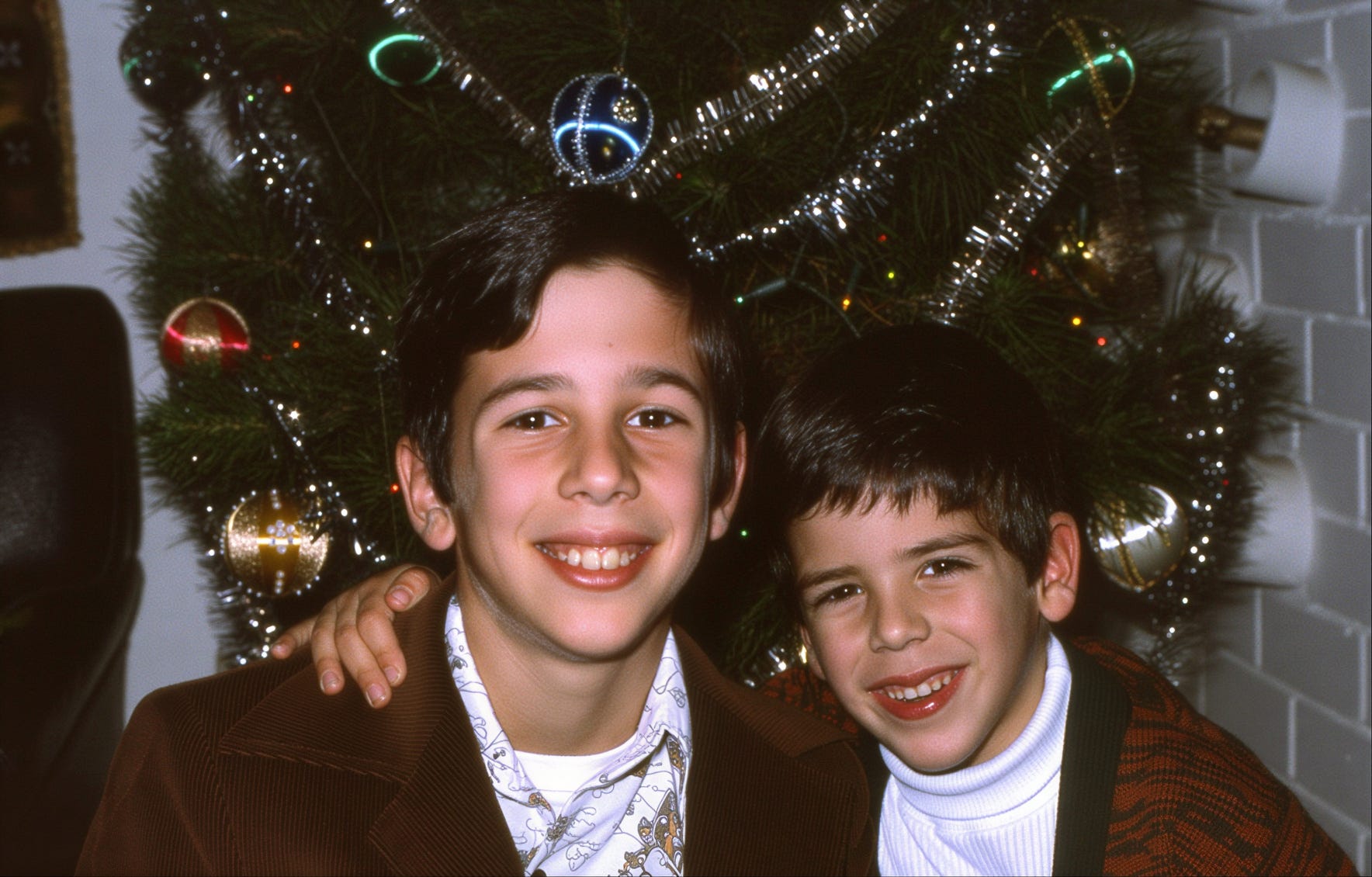
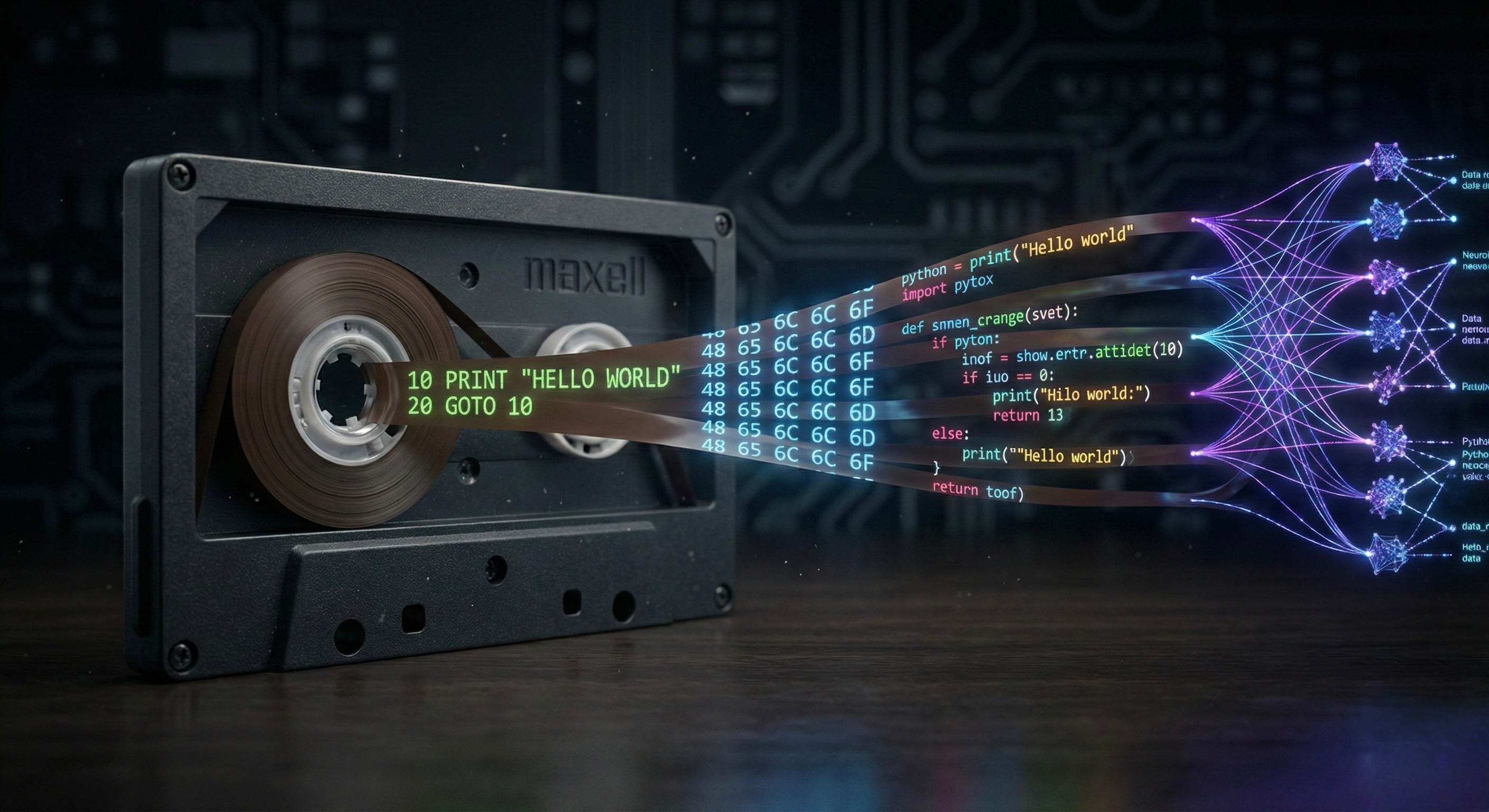
The cassette player made a sound like a modem drowning. That’s how you loaded a program in 1979: you hit play, waited, and hoped.
My father worked at JPL. The TRS-80 came from Radio Shack. It wasn’t for me; I was too young. It was for my older brother, Michael, who had already taught himself BASIC and was building something ambitious: a text-based adventure game. Rooms. Inventory. Choices that mattered. I remember watching him type, the grey phosphor glow lighting up his face.
Michael had Leukemia. He died in the early 80s, before he finished the game.
The Code That Made No Sense
Michael was my best friend.
After he died, I didn’t know what to do. I remember sitting at the TRS-80, staring at the grey screen, just ... blank. The house felt wrong. Everything felt wrong.
At some point, I found his cassette. I loaded it up. The BASIC code scrolled across the screen: GOTOs and IF-THENs and string variables I didn’t understand. It looked like a foreign language written by someone I loved.
I asked my mom to drive me to the library.
She did. I came home with books on BASIC, thick paperbacks with code listings in the back. I taught myself. It took weeks. Eventually, I understood enough to see what Michael was building. And eventually, I finished it: not how he would have, but how I thought it should go.
That cassette taught me something I didn’t have words for yet: code is a conversation with someone who isn’t there anymore.
The Trajectory
I got hooked. My parents bought an Apple IIe. I learned assembly language, then how to disassemble other people’s programs, then how to make them do what I wanted. I got a modem. Then a second phone line. I ran a BBS (I think it was GBBS) with an Apple-CAT II modem that let me do things the documentation said you couldn’t.
In sixth grade, I started a computer club at my school. I wrote a monthly newsletter with little programs people could type in and run. I think I was eleven or twelve. I had no idea what I was doing, but I knew it mattered.
And somewhere in there, I started having conversations with my father.
The Prediction
This is the part that still surprises me.
We were talking about programming: Pascal, assembly, the layers of abstraction between human thought and machine instruction. I remember saying something like: “Eventually, we’ll just talk to computers. We’ll describe what we want, and they’ll write the code.”
My dad worked at JPL. He’d seen things I couldn’t imagine. But I remember his face: curious, skeptical, maybe a little amused. Like he wasn’t sure if his son was ahead of the curve or just a kid with big ideas.
I didn’t know the phrase “natural language processing.” I just knew that the trajectory was obvious. Every layer of programming got higher, more abstract, closer to how humans actually think. Why would that stop at Pascal? Why would it stop at anything?
The Minor Nobody Understood
In 1990, I went to college and minored in AI.
This was before AI meant what it means now. There were no neural networks in your pocket, no chatbots that could pass the Turing test on a bad day. AI was expert systems and symbolic logic and a lot of people saying “interesting, but impractical.”
My major was philosophy. My minor was AI. People thought I was nuts.
It made perfect sense to me. I was studying how humans think and how machines might think. The connection was obvious. The timeline was not, but I wasn’t in a hurry.
As I wrote in One Writer, Three Worlds, Morphic exists for the ideas that refuse to fit neatly into one box. This is one of those ideas: part memoir, part systems thinking, part long-arc validation.
The Long View
Here’s what I want to say to my father now, if I could:
You listened.
That’s it. That’s the whole thing.
You worked at JPL. You knew more about real systems than I ever will. And when your twelve-year-old son said “someday we’ll just talk to the computer and it’ll write the code,” you didn’t dismiss it. You engaged. You asked questions. You let me think out loud.
I don’t know if you believed me. I don’t know if I believed me. But you gave me space to follow the thought, and that space became a career, a worldview, a way of seeing systems that I still use every day.
The same instinct that led me to predict natural language programming is the instinct behind Stop Paying for Mac Cleaners: when I see friction, I build. When I see a trajectory, I follow it. Michael’s cassette taught me that code is a conversation. My father taught me that conversations are how ideas survive long enough to become real.
Forty Years Later
The prediction came true. You can talk to a computer now and it will write the code. The cassette player is long gone.
But the conversation? That's still running.

Author’s Note: This is personal nonfiction. It reflects my perspective and memory, which are imperfect instruments. I’ve tried to be honest about what I don’t know.
Further Reading
The Dream Machine by M. Mitchell Waldrop The story of J.C.R. Licklider and the vision of human-computer symbiosis that preceded everything we now call “AI.”
History of Natural Language Processing (Wikipedia) From ELIZA to GPT: how the field evolved from parlor trick to paradigm shift.
Ambiguous Loss by Dr. Pauline Boss The framework for understanding losses that lack closure. Michael’s death, and the code he left behind, fits this pattern.