

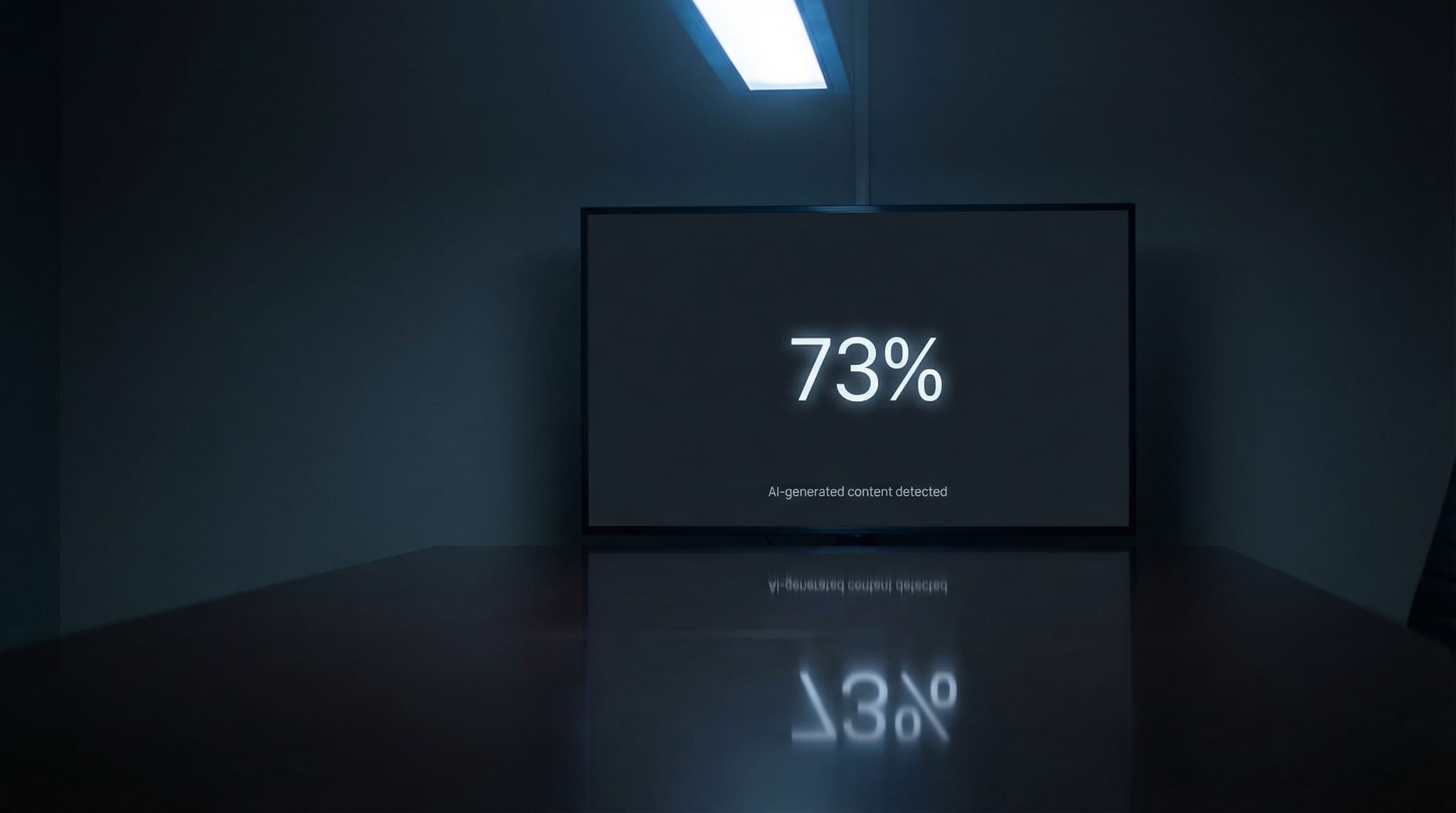
A professor submits a student paper to an AI detector. The tool returns: 73% AI-generated. The professor files a misconduct report.
The student wrote every word.
This is not a hypothetical. The Markup documented this in 2023: international students flagged for academic misconduct because the way they write English, carefully, with simpler sentence structures and repeated phrasing, scores as statistically consistent with AI output. The detector was confident. The detector was wrong. And the confidence is what made it dangerous.
WHAT DETECTORS ACTUALLY DO
AI text detectors do not read writing the way a human does. They measure perplexity: how surprising is each word choice given what came before? High perplexity means unpredictable word choices. Low perplexity means predictable ones. AI-generated text tends toward low perplexity because language models select statistically likely words.
The problem: careful writing, formal writing, second-language writing, all tend toward low perplexity too. Simple sentences. Conservative vocabulary. Consistent structure. The detector has no way to separate “human writing that looks like AI output” from “AI output.” It calculates a probability. It presents that probability as a verdict.
Stanford professor James Zou and colleagues published on this directly. Non-native English writers had false positive rates as high as 61.3%. For international students specifically, the risk of a false accusation could reach 97%. The tool was not broken. It was doing exactly what it was built to do. The error was in treating the probability as evidence of intent.
Perkins, Roe, et al. tested seven of the most widely used detectors across 114 samples in 2024. Baseline accuracy: 39.5%. After applying simple adversarial techniques, accuracy dropped to 17.4%. The tools were already unreliable before anyone tried to game them. They collapsed faster when someone did.
A system with 39.5% accuracy in controlled testing is not a verification tool. It is a coin flip with a confidence display.
THE SAME ERROR, TWICE
Here is where the argument gets uncomfortable for both sides.
The people being accused of using AI to write are are no different than those trusting AI output without scrutinizing it either. They generate, they paste, they publish. They rely on the model’s output as good enough without reading it for what it actually claims or whether it represents their actual argument. The model said it, so it’s done.
Both groups are making identical moves. Treating a probabilistic system’s output as a finished verdict rather than a signal that requires judgment.
The AI user trusts the generator. The AI skeptic trusts the detector. Both treat the model’s confidence as their own. Neither is asking what the model can actually know.
The symmetric failure is the real story. Not the question of whether AI use is ethical or lazy or acceptable. Both of those debates are downstream of the same miscalibration.
A NOTE ON THE TOOLS
I’ve built data analytics systems for significant companies. Classification models. Detection pipelines. Anomaly scoring. I know what these tools look like from the inside, and I know what gets left out of the confidence display.
Even enterprise-grade systems, built with proper data science teams and substantial validation cycles, routinely operate at error rates that would make most non-technical users uncomfortable if they saw the raw numbers. False positive budgets get set as business decisions, not scientific ones. Thresholds get tuned to minimize one error type while hiding another. The confidence display is a product choice. Not a measurement.
AI text detectors are not enterprise-grade. They are first-generation, perplexity-based classifiers deployed into institutional contexts with institutional authority. Perkins et al.’s 39.5% baseline accuracy would not pass internal review at most serious analytics organizations. It would get sent back with a note: not production-ready.
Here is the part that should make the skeptic pause. The person who distrusts AI enough to run a text detector is relying on another statistical model to confirm that distrust. They have not escaped the problem. They have doubled it. Trusting a generator’s probabilistic output and a detector’s probabilistic output simultaneously, and calling the combination proof.
That is not skepticism. That is symmetrical credulity.
WHEN CALIBRATION BECOMES A TEAM
The problem becomes structural when it turns tribal.
There is a documented polarization in how AI is discussed: accelerationists who treat adoption as obviously correct, doomers and skeptics who treat AI use as obviously suspect. Forbes documented the growing heat between these camps in February 2025. The discourse resembles a political argument more than a technical one. Positions are held first. Evidence is consulted only when it confirms what was already believed.
The AI detector user who sees a high probability score and files a misconduct report is not evaluating evidence. They are confirming a prior. The number crossed a threshold. That was enough.
This is the same mechanism that makes political misinformation stick. Find a data point that supports the position. Stop looking. A 73% AI-probability rating becomes “this person cheated” by the same logic that makes a misleading chart feel like proof. The source is unreliable. The conclusion is certain. The certainty is the tell.
What is driving this is not a genuine technical disagreement about AI capability. It is an epistemological failure that tribalism accelerates. Both sides are wielding bad tools. Only one side is currently losing jobs and grades over the verdicts.
WE HAVE SEEN THIS BEFORE
In the late 1990s, I took a course at a local college on digital photography and Adobe Photoshop.
The arguments happening then sound familiar.
Digital photography was not “real” photography. You were not earning your images the way film photographers earned them. Photoshop was cheating: it let anyone who could click a mouse claim a skill that took years to develop with a darkroom and chemical trays. You were not a true photographer if you were working in pixels. The gatekeeping was confident, defensive, and grounded in a very human anxiety. The new tool was going to devalue what the prior tool had cost to master.
Those critics were simply wrong.
Digital photography did not destroy photography. Photoshop did not make every image meaningless. Both expanded what was possible and shifted where skill actually lived. The people who needed film processing to feel like artists found their craft was more portable than they feared. The people who were mostly relying on the mystique of film without the underlying skill got found out faster. The tool change clarified where the actual work was.
Twenty-five years later, the same argument is running again. In the same voice.
AI is not “real” writing. Using it is cheating. You are not a true writer if a language model touched your draft. The confidence is the same. The defensiveness is the same. The underlying anxiety, that a new tool devalues what the prior method cost, is identical.
The Photoshop debate got resolved by time. You can watch the resolution from here. The AI detector gives the skeptic a device that feels like evidence. It does not change what history says about where these arguments end up.

THE TOOL THAT ACTUALLY WORKS
I use AI to create images. I am not a trained visual artist.
What AI image tools gave me was not skill I did not have. It was the ability to close the gap between what I could see in my head and what I could put into the world. The specific mood. The composition. The light quality and texture and tonal feel of a visual idea that existed clearly in my mind but stopped at my hands. For years, that gap between aesthetic judgment and technical execution just meant the thing stayed in my head.
That gap is now crossable.
This is not the same thing as what AI text detectors do. But it is the same argument about AI as a tool. I do not prompt once and accept whatever the model returns. The iteration, the rejection, the direction-giving, the refinement cycle toward a specific result: that is the work. The model did not supply the vision. It executed the vision, approximately, until approximately became right.
The Photoshop parallel holds here. Photoshop did not replace photographers who understood light and composition. It gave people who understood those things more direct access to the result. AI image tools do the same. The skill that matters did not disappear. The bottleneck that was hiding it did.
If your objection to tools that expand the range of what people can express is really about the expansion itself, that is a different conversation entirely.
WHAT HAPPENS WHEN SYSTEMS ACT ON THIS
The AI detector verdict is already embedded in institutional decisions. Academic misconduct cases. Content moderation queues. Hiring filters. Fraud detection pipelines.
Each of those is a system built on a signal with 39.5% baseline accuracy. Each downstream consequence carries the confidence of a verified finding. None of that confidence is warranted by the underlying tool.
This is the same pattern from the last piece. Surveillance does not measure behavior. It measures behavior under observation. AI detectors do not measure authorship. They measure statistical patterns that correlate with AI output under specific conditions. Both produce a number. Both present the number as ground truth. Both systems are wrong about what the number means.
The institution acting on these verdicts is not asking whether the detection layer is reliable. It is asking whether the threshold was crossed.
THE CALIBRATION PROBLEM
The argument is not that AI detectors are useless. The argument is that they are probabilistic tools being used as forensic ones.
A weather model that outputs 70% rain probability is useful. Canceling an outdoor event on a clear morning because the threshold was crossed is a calibration failure. The model gave a signal. The human replaced their judgment with it.
The 73% AI-generated verdict is a signal. The correct response is more questions: Is this a non-native English writer? Is this a highly formal document type? Has the text been edited from AI output or written from scratch in a constrained style? The signal closes none of those questions. But it is being used to close the inquiry entirely.
Calibration failures become permanent when they get institutionalized. When the threshold becomes policy, the error rate becomes the policy’s error rate. Nobody audits that.
When the network’s interpretation of your work cannot be trusted, keeping more of what you produce in your own hands stops being a preference. It becomes how you stay legible to yourself, and to anyone who needs to understand what you actually built.
Resources
AI-Detectors Biased Against Non-Native English Writers — Stanford HAI (2023) — James Zou et al.; 61.3% false positive rate for non-native English speakers; up to 97% false accusation potential for international students in academic settings.
GenAI Detection Tools, Adversarial Techniques and Implications for Inclusivity in Higher Education — Perkins, Roe, et al. (2024) — International Journal of Educational Technology in Higher Education (Springer Nature). Baseline accuracy 39.5%, drops to 17.4% under simple adversarial techniques; 7 detectors, 114 samples, 805 tests.
AI Detection Tools Falsely Accuse International Students of Cheating — The Markup (2023) — Documented cases of students flagged for misconduct by AI detectors.
AI Doomers Versus AI Accelerationists Locked In Battle For Future Of Humanity — Forbes (2025) — Documented polarization between AI skeptics and accelerationists.
Ethics in the Age of Digital Photography — National Press Photographers Association — NPPA’s ongoing ethics standards around digital manipulation; the photojournalism community’s documented struggle with Photoshop norms through the 1990s and 2000s.
Privacy Is a Luxury Good — Morphic (2026) — Previous arc piece: surveillance creates distorted signal; the most monitored users produce the most corrupted data.