

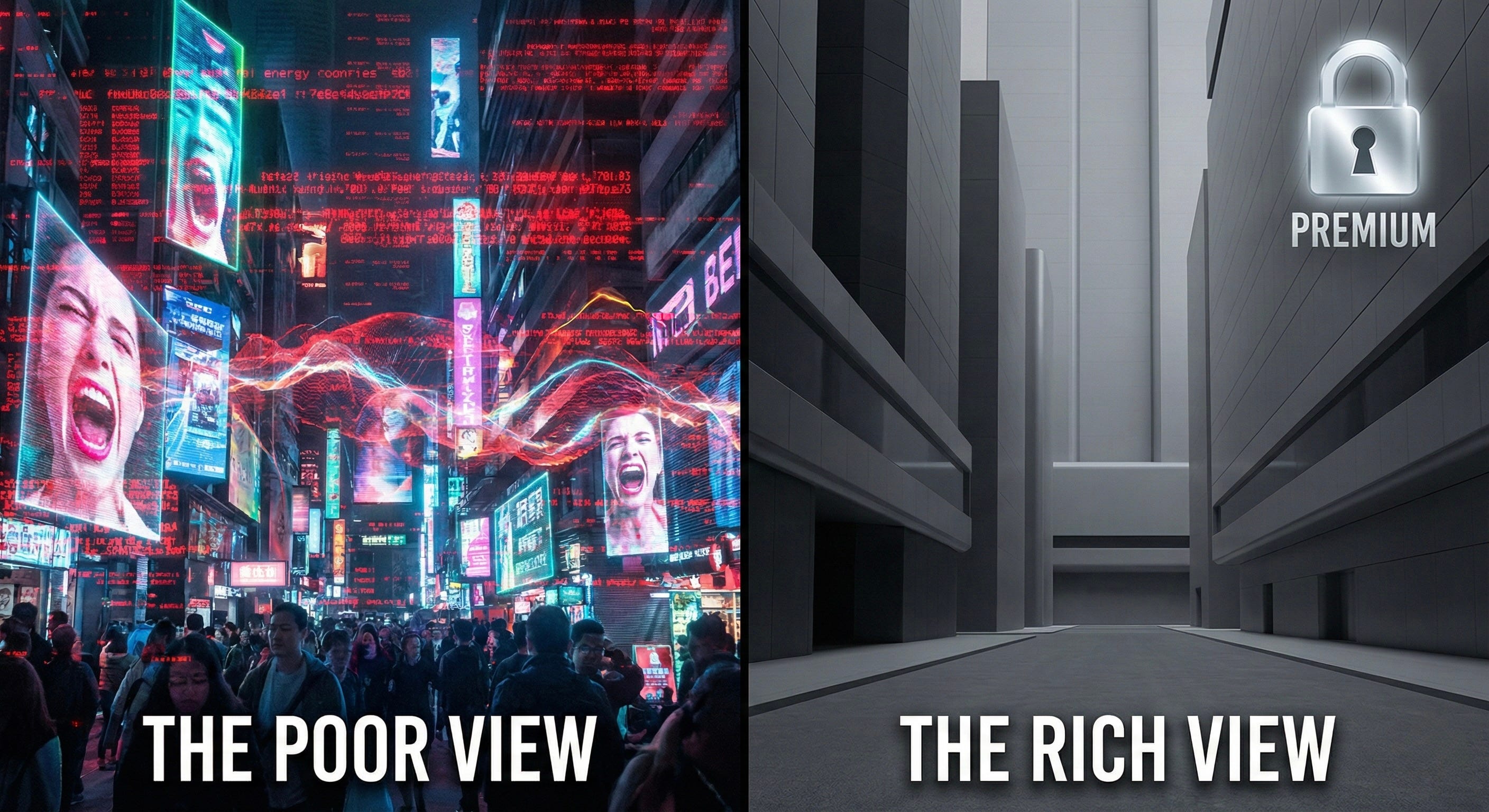
My wife and I were in China last October, and we hopped on a bus in one of the high-tech districts.
It didn’t look like a vehicle. It looked like a rolling browser window.
The windows of the bus weren’t glass anymore; they were transparent OLED screens. As we passed a shopping complex, the window overlaid a floating burger onto the street for the passengers inside. As we passed a fashion district, a high-definition video overlay of a model appeared to walk alongside the bus, keeping pace with the wheels on the digital glass.
Inside, I watched the silhouette of a passenger pressed against the window. They were motionless, eyes glazed, bathed in the blue light of the ad.
Standing next to me, a teenager was staring at their phone. The tinny, leaking audio from their earbuds was screeching a sped-up TikTok audio track that sounded like a chipmunk having a panic attack.
I closed my eyes. I couldn’t close my ears.
It hit me then, standing in that neon glow. We aren’t witnessing a “class war” or a political divide. We are witnessing a fundamental inversion of the human baseline.
For 99% of human history, silence was the default setting of the world. Noise was the exception. You heard a bird, a storm, or a conversation. If you wanted music, you had to make it. If you wanted a story, you had to tell it.
In 2026, the settings have flipped. Noise is now the default. Silence is the anomaly.
The Attention Economy Abhors a Vacuum
It is easy to blame “greedy corporations” for this, but that is lazy thinking. It is simply market efficiency.
Markets are engines that solve problems. For a century, the problem was “boredom.” We didn’t have enough information or entertainment. So, the market built radios, then TVs, then the Internet, then the smartphone.
We solved the boredom problem so effectively that we created a new scarcity: Focus.
The economy realized that if silence is the default, no money changes hands. But if noise is the default, then silence becomes a value-add product.
This isn’t about rich neighborhoods versus poor neighborhoods. It is about the “Opt-Out” economy.
Think about your own daily friction points.
Your phone buzzes by default; you have to dig into settings to turn it off.
The gas pump plays a video ad by default; you have to hit the “Mute” button (if it exists) or get back inside your vehicle.
The news feed is algorithmic by default; you have to curate your own list to see chronologically.
We are living in a world where the passive path, the path of least resistance, is a path of constant interruption. To find peace, you now have to exert active, disciplined energy.
The Loss of the Internal Monologue
The real danger here isn’t that we are being annoyed. It is that we are being hollowed out.
When the external world is constantly filling your ears and eyes, the internal world stops spinning. You cannot reflect on a complex idea while a 15-second audio loop is drilling into your auditory cortex.
We are outsourcing our internal monologue to the feed.
I see this everywhere. People can no longer stand in line at the grocery store for 45 seconds without pulling out a screen. We are terrified of the void. We have become so accustomed to the input that the silence feels heavy, almost oppressive.
So we pay for the “Premium” subscription not to gain something, but to remove the barrier we built. We buy the noise-canceling headphones to block out the world. We pay for the ad-free tier to block out the commerce.
We are paying a tax to return to the baseline of 1990.
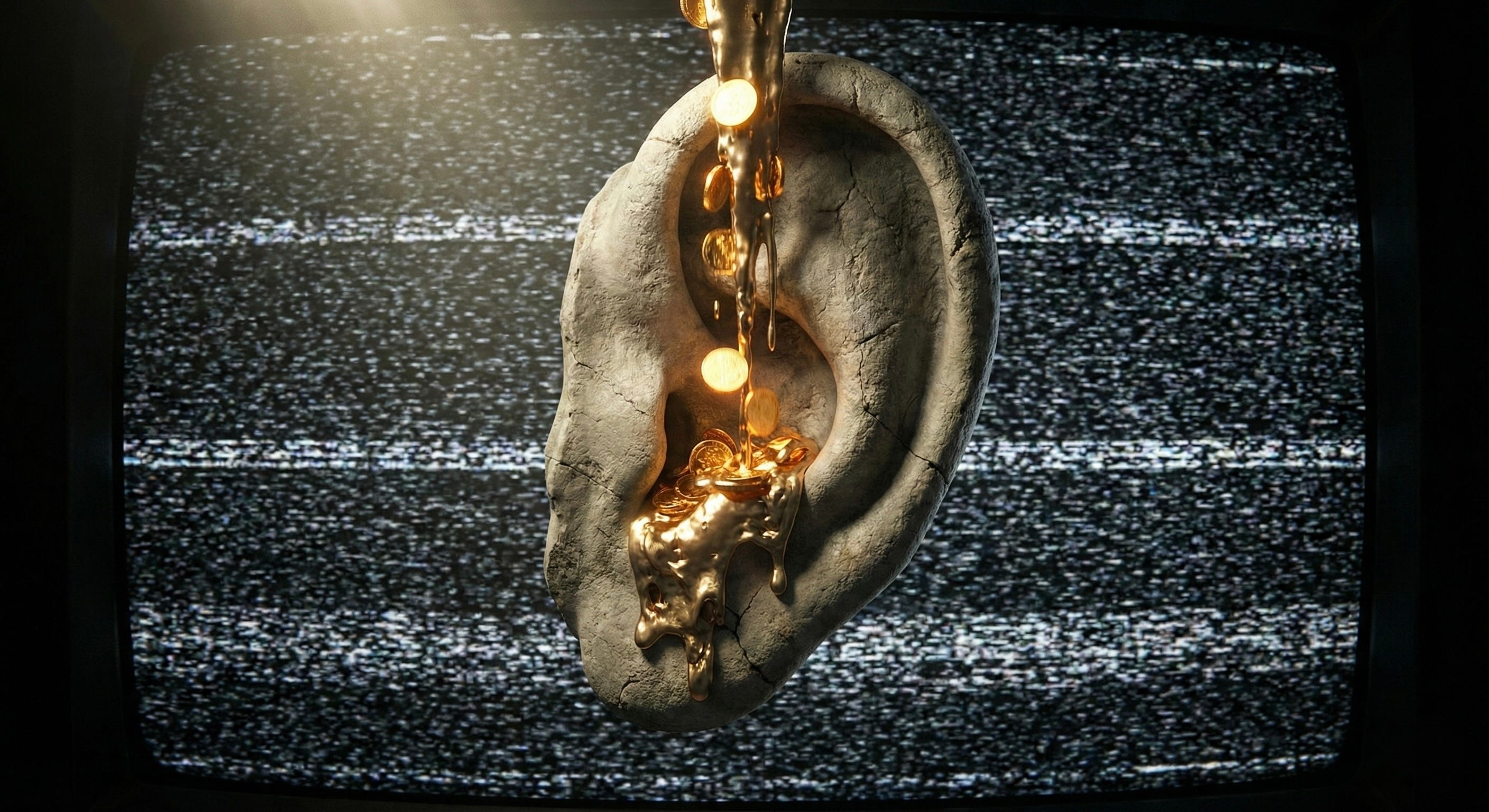
The Noise Gap is Internal
There is a lot of talk about inequality, but the most profound gap I see isn’t between tax brackets. It is between those who have retained the ability to sit with their own thoughts and those who haven’t.
You can be a billionaire and be a slave to your notifications. You can be a monk with zero assets and own your headspace completely.
This is a matter of agency, not assets.
The technology I saw in China… the transparent screens, the immersive ads… is coming everywhere. It is the logical conclusion of an economy based on impressions. If a surface exists, it can be monetized.
But we have a choice.
We can accept the noise as the new normal, drifting through a world of “Suggested Content” and “Partner Offers.” Or we can recognize that silence is a resource that must be actively defended.
Analog Resistance
So how do we reclaim the void without just complaining about modern life?
It requires a conservative approach to technology; ”conservation” in the literal sense. We need to conserve our cognitive resources.
It looks like “Analog Resistance.”
Leave the hardware: Go for a walk without the phone. Not on “Do Not Disturb,” but physically absent. Let the world be boring.
Shield the eyes: Read a physical book on the bus or the plane. It acts as a literal shield against the visual spam of the environment.
Defend the ears: Don’t wear headphones to pump more noise in; wear them to keep the world out, sometimes with nothing playing at all.
Silence is no longer a natural right given to us by the environment. It is a discipline we have to cultivate within ourselves.
The world is going to get louder. The screens are going to get brighter. The only quiet place left is the one you build inside your own head.
Validated Resources
The Noise Gap: Inequality in Soundscapes - The Atlantic’s analysis (still relevant) on how noise pollution disproportionately affects lower-income communities.
Health Effects of Environmental Noise - World Health Organization guidelines linking chronic noise exposure to cardiovascular disease and cognitive impairment.
Reality Blocker Concepts - Theoretical and practical applications of AR being used to “erase” real-world advertising.
Solitude Deprivation - Cal Newport's concept (based on "Digital Minimalism") that we are the first humans to never be alone with our thoughts.