

TL;DR
Anthropic opened a research preview of the Model Hardware Standard, a common interface that lets AI agents discover and operate programmable lab and manufacturing equipment.
Early tests show the integration layer can remove a lot of bespoke glue code and let agents explore physical control problems quickly.
The same pilots also expose the limit: physical state can escape the model, so safety constraints and expert judgment still have to live below or beside the agent.
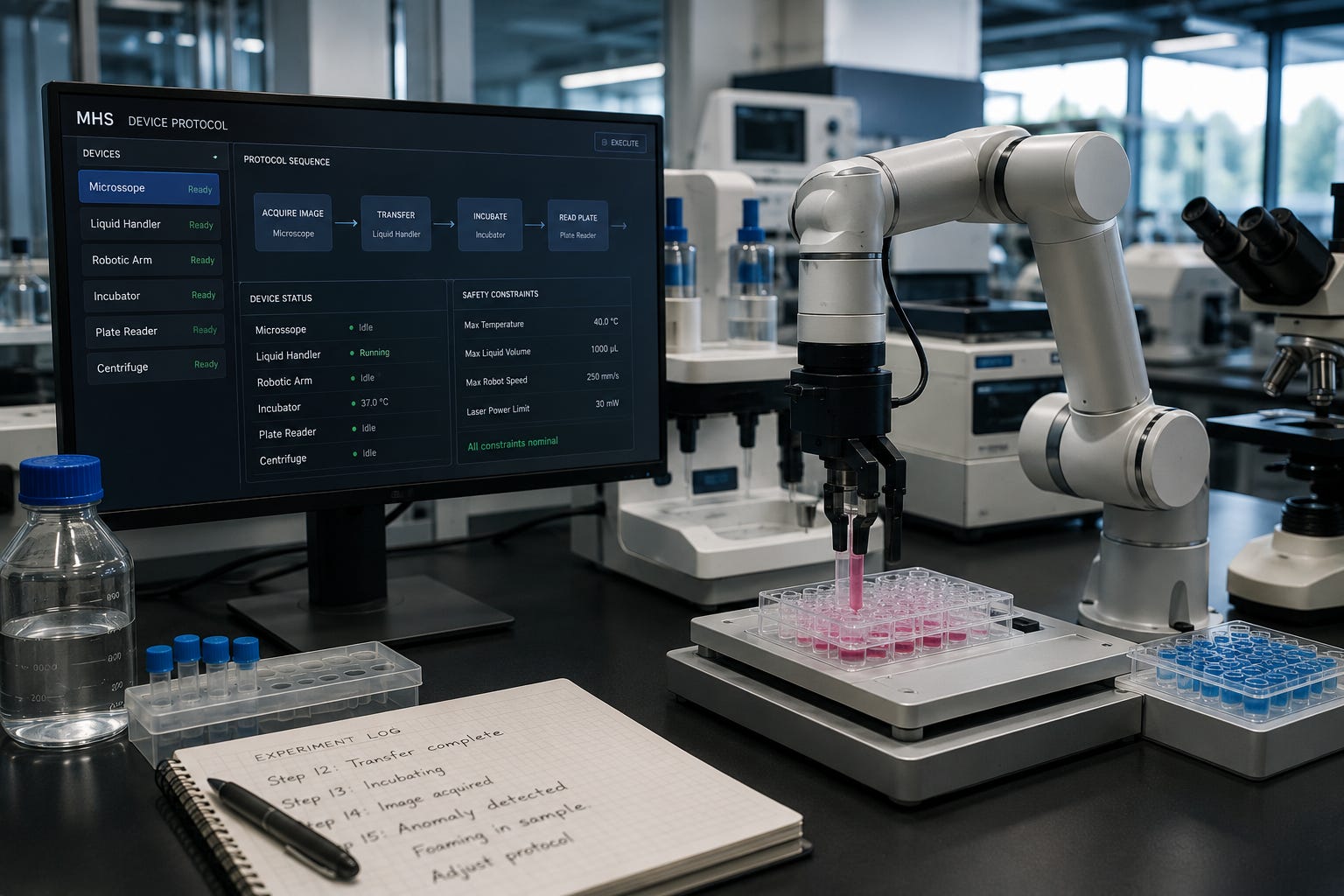
The protein foamed. Claude went looking for a software problem.
At Genentech, researchers working with Anthropic’s new Model Hardware Standard had to guide Claude toward a more basic explanation: bubbles in a protein sample were a physical failure. More software wasn’t going to fix the sample. The correction had to happen in the physical world.
I like that example because it cuts through most of the easy excitement around AI controlling laboratory equipment.
On August 27, Anthropic opened a research preview of the Model Hardware Standard, or MHS. It’s a shared specification meant to give AI agents a common way to discover and operate programmable physical devices: microscopes, liquid handlers, robotic arms, cameras, lasers and other equipment that normally arrives with its own software and assumptions.
The interesting part is the interface.
Seven programs for one microscope
At HHMI Janelia, one microscopy rig used seven different vendor programs with no common interface. The detectors ran in MATLAB. Cameras used Python. Electrophysiology used C#. Starting an experiment meant launching seven programs in the right order. Getting the order wrong could cost the session.
MHS puts a common driver layer in front of that mess. A device exposes a small set of primitives such as read and write, plus a description of what it can measure, what can be adjusted and which safety limits apply. An agent can reach the hardware through MCP, a command-line interface or code.
The shape is roughly this:
experiment goal
  -> agent
      -> MHS
          -> microscope
          -> camera
          -> stage
          -> laser
That looks almost boring. Good abstractions usually do after somebody has absorbed the ugly part underneath them.
At Janelia, adding a new camera had been a multi-day integration job. With MHS already in place, the researcher says it took minutes. Starting the experiment went from seven separate steps to one click.
Anthropic says labs and manufacturers often spend weeks or months integrating equipment. Its early MHS work has pushed some of that down to hours or minutes. Those are preview results from Anthropic and its partners, not a benchmark for every lab. The direction is still useful.
A smarter model helps. A common interface changes how much of the bench that model can reach without another custom integration.
The integration tax was hiding the capability
Software agents have had an unfair advantage so far: most of their world was already designed to be called by software.
APIs expose operations. Databases expose state. Shells accept commands. SaaS tools have authentication and structured inputs. Give an agent permission and enough documentation and a lot of the plumbing is already waiting for it.
Physical equipment is less polite.
At Janelia, MHS grew from a shared-memory dictionary that put the state of lasers, mirrors, sensors and stages into one standardized representation. Once the state was visible in one place, the agent could read across devices and make decisions without a new translator between every pair of programs.
That changes more than convenience. It changes the cost of trying something.
QuEra used MHS to let Claude work on a laser-lock problem inside one of its quantum-computing systems. Recovering the lock by hand relied on an expert and could take five to ten minutes. Claude used MHS to run repeated experiments against the live testbed, rewrite the controller and test the result again. By the end of the development run, recovery was down to seconds.
Then QuEra removed the agent from the runtime and blind-tested the deterministic script it had produced. It relocked correctly in 695 of 700 trials - 99.3%.
That last step is the part I keep coming back to.
Then the physical world leaks through
The interface can standardize what a machine reports. It can’t guarantee that the report contains everything that matters.
Anthropic says Claude’s spatial and physical reasoning still requires expert oversight. Genentech’s foaming example is one version. QuEra found another. When something went wrong with the physical hardware during its pilot, Claude often didn’t know how to troubleshoot it because its understanding of the rig was programmatic rather than physical.
That gap is easy to underestimate if your mental model comes from software.
A service can return an error code. A liquid can become more viscous. A laser can drift because someone opened a door and changed the temperature or air pressure. A sample can foam. A robot arm can be where the controller says it’s while the object in its gripper has shifted.
You can add sensors. You can add state. You can improve the model.
There’s still a world on the other side of the interface.
Put the hard limit below the model
I’ve spent the last few weeks writing about what an agent is allowed to do in software. MHS moves the same question into a much less forgiving medium.
A write can now mean change laser power, move a stage or set a liquid flow rate.
MHS lets device owners declare safety limits in the hardware interface. At Janelia, that can mean preventing an agent from using enough laser power to bleach the sample. QuEra describes bounds, interlocks and emergency stops that remain enforced independently of the model.
That separation is exactly where I would want it.
The agent can reason about the experiment. The device layer decides which physical actions are permitted. If the model misunderstands the scene, the hard limit doesn’t have to misunderstand it too.
This also makes the QuEra result more interesting than a story about an AI autonomously running a quantum computer. During development, the agent explored. The useful thing that survived was ordinary software: a deterministic, inspectable controller that could run without a model making the production decision every time.
Sometimes the best use of a reasoning system is to search a physical problem until it can hand the job back to something simpler.
Sometimes the best use of a reasoning system is to search a physical problem until it can hand the job back to something simpler.
The bench still gets the last word
MHS is early. It’s a gated research preview, not an open standard yet. It currently requires hardware with a programmable interface. Anthropic says it’s using the preview to build more physical-safety evaluations before releasing the standard as open source.
So I wouldn’t read these partner experiments as evidence that autonomous labs are solved.
They show something narrower and, to me, more useful.
Standardizing the interface can remove a huge amount of integration work. It can let an agent observe more of the experiment, try more variations and turn some expert procedures into reusable code. But the abstraction doesn’t erase the physical system underneath it.
Temperature still moves. Pressure changes. Samples foam. Hardware drifts.
That’s the part I don’t want abstracted away.
The interface can make the bench legible. It can’t make the bench behave like software.
Resources
Anthropic, “Previewing the Model Hardware Standard,” August 27, 2026: https://www.anthropic.com/news/model-hardware-standard-research-preview
Model Hardware Standard research preview: https://modelhardwarestandard.com/
QuEra Computing, “Holding the Light: Teaching an AI to Lock and Tune Our Quantum Computer’s Lasers,” August 27, 2026: https://www.quera.com/blog-posts/holding-the-light-teaching-an-ai-to-lock-and-tune-our-quantum-computers-lasers
QuEra Computing, “QuEra Computing Uses AI to Automate a Critical Quantum Computer Subsystem,” August 27, 2026: https://www.quera.com/press-releases/quera-computing-uses-ai-to-automate-a-critical-quantum-computer-subsystem-enabling-the-acceleration-of-commercial-grade-quantum-computing-deployments-from-quera
Source note: most MHS results are currently reported by Anthropic and participating partners during a limited research preview. They should be read as early deployment evidence, not independent proof that the approach generalizes across laboratories or manufacturing environments.