

TL;DR
In an October 22 study, 13 of 41 clinically unresponsive patients used a noninvasive brain-computer interface to change a beeping sound.
The interface didn’t decode words or let patients hold a conversation. It detected a much simpler, deliberately controlled signal.
A negative result isn’t proof of unconsciousness. Even some patients who were clearly conscious couldn’t make the system work.
Imagine being asked to move your hand, understanding the instruction and being unable to make your hand move. If there’s no visible response, how do you know whether the person didn’t understand or simply couldn’t move?
That’s a question researchers at Columbia are trying to answer. In a study published October 22 in Brain, they gave some patients with severe, recent brain injuries a different way to respond: change the timing of a beeping sound using electrical activity recorded from the scalp.
The patients were described as clinically unresponsive. That means their bedside examinations didn’t show the expected responses to commands. It doesn’t mean the researchers had established that every patient was unconscious.
Thirteen of the 41 patients managed to control the sound.
That’s more interesting to me than another headline about computers reading our minds. The researchers didn’t read anyone’s thoughts. They asked for a specific mental task and looked for a matching signal. In some patients, that gave them something the usual bedside examination couldn’t: evidence of a deliberate response.
A bedside test can miss a person who’s trying
When a doctor asks a patient to squeeze a hand or follow a moving finger, the response has to travel through several steps. The patient needs to hear and understand the request. They need to decide to act. Their brain must send the appropriate signals to the muscles, and those muscles have to move enough for someone to notice.
A patient with a major brain injury can fail somewhere along that path. If nothing moves, the doctor has observed a lack of movement. That observation alone can’t tell the doctor which step in the chain failed.
Researchers call one version of this problem cognitive motor dissociation. In ordinary terms, brain activity shows the patient following a command even though the bedside exam shows no response to that command. You may also see it called hidden or covert consciousness.
In a 2024 study published in The New England Journal of Medicine, researchers at six centers detected this kind of hidden command-following in 60 of 241 patients who showed no visible response to commands. They used brain scans or recordings of electrical activity. Unlike the new acute-care study, it included many people assessed months after their injuries. That’s 25% of the unresponsive group they studied, not 25% of every hospitalized patient.
Those tests could show that a brain responded to instructions. They didn’t give the patient a way to send a message back.
The new experiment asked a different question. Could a patient deliberately use the detected brain activity to control something, while the system was running?
A beep, not a conversation
Columbia’s team, led by neurologist Jan Claassen, used an electroencephalogram, usually shortened to EEG. Small electrodes on the scalp record patterns of electrical activity produced by groups of brain cells. There was no implanted chip and no surgery to connect the patients to the computer.
A patient heard a repeating tone through headphones. A recorded instruction asked the patient to try to open and close their right hand to make the beeps faster. To slow them down, the patient was told to stop trying that movement.
A computer analyzed the EEG signals as they arrived and adjusted the sound. The system also gave spoken feedback so a patient could hear when the change happened.
During the first part of training, the tone partly followed the expected response to the commands. The researchers counted control only in a later ten-minute test, when the decoder’s settings were fixed and it had to work from the EEG.
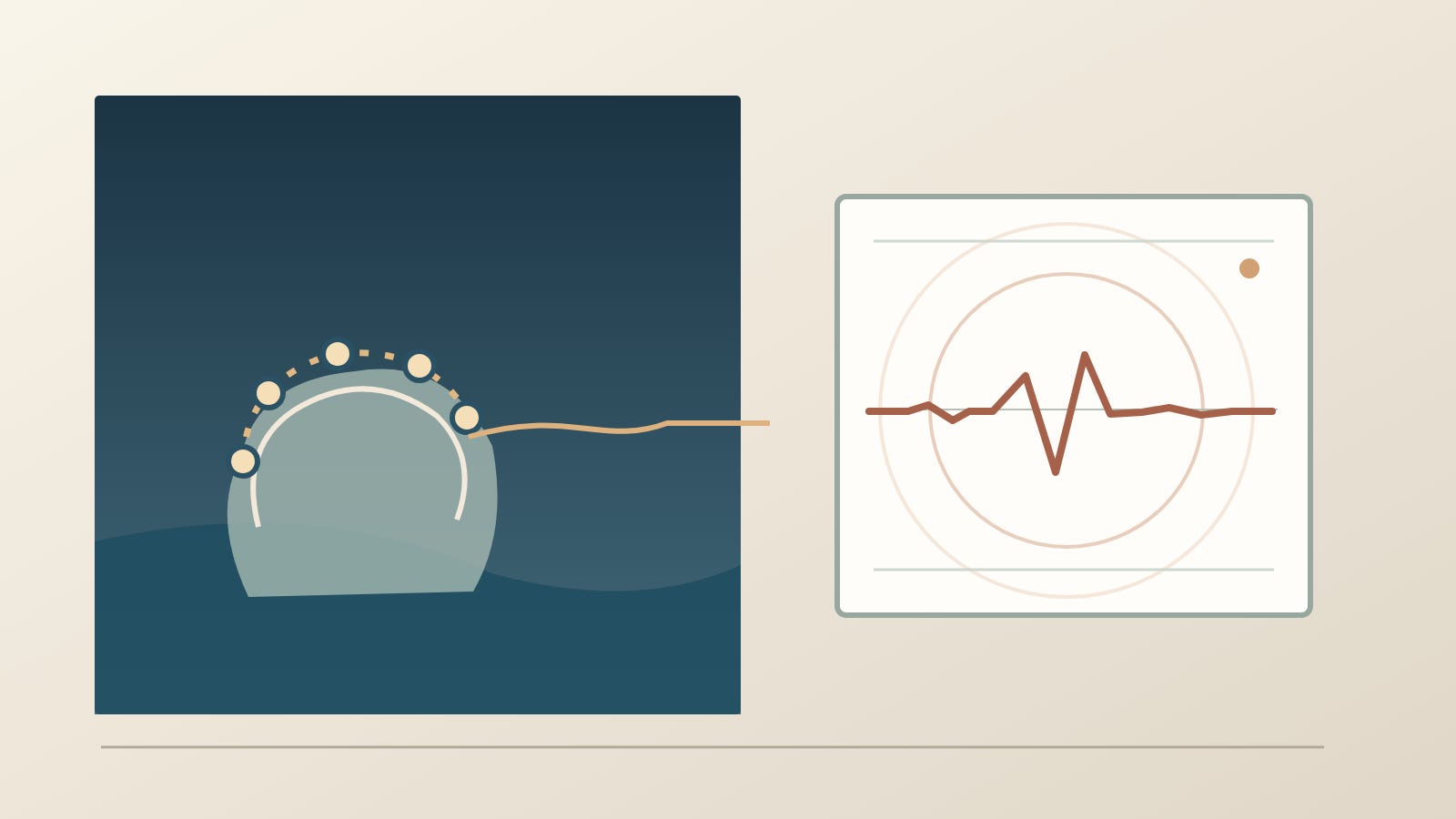
The signal path: Spoken instruction → attempted hand movement → scalp EEG recording → computer analysis → changed beep.
The hand didn’t have to move. The system was looking for brain activity associated with attempting the task.
That’s what a brain-computer interface means here: software turns a measured brain signal into a limited action outside the body. In this case, it altered a sound. It didn’t translate a private thought, identify a feeling or figure out what the patient wanted for dinner.
The timing numbers need care, too. Across the ten-minute test, the researchers estimated how far the decoded EEG output lagged behind the command sequence. The median estimated delay was about 50 seconds in the clinically unresponsive group and about 17 seconds in the conscious hospitalized group. That was an estimated lag across the test, not the measured time needed to answer a single question.
The researchers describe this as a one-way interface. Patients could change the tone, but the study didn’t demonstrate a reliable way for them to answer yes-or-no questions or tell a doctor where something hurt.
The negative result is the part I’d be careful with
The published study included three groups: 41 clinically unresponsive patients with acute brain injury, 22 conscious critically ill patients and eight healthy volunteers.
All eight healthy volunteers controlled the interface. But only nine of the 22 conscious hospitalized patients did. The other 13 couldn’t make the system work, despite being conscious.
That changes how I’d interpret a negative test. Failure could reflect fatigue, illness, fluctuating attention, trouble performing the task or difficulty detecting the signal. The study wasn’t designed to prove which explanation applied to every person.
Eight of the 41 unresponsive patients tested positive on a separate EEG-based test for hidden command-following. Thirteen controlled the tone. These weren’t interchangeable tests: the study’s supplementary patient table includes patients who succeeded on one but not the other.
That’s promising evidence that a different kind of task can reveal an ability another test missed. It isn’t proof that the interface can reliably tell whether any individual patient is conscious. A positive, deliberately controlled response is important evidence. An absent response leaves a lot unresolved.
I wouldn’t want a family to hear that their loved one ‘failed the consciousness test’ when even some conscious patients couldn’t complete it.
What the recovery numbers can and can’t tell us
The researchers followed the patients after the experiment. By 12 months, six of the 13 unresponsive patients who controlled the tone reached the study’s definition of functional independence. That meant they could manage independently for at least eight hours in a day, based on a standard clinical outcome scale. Among the 28 who hadn’t controlled the tone, two reached that outcome.
The difference is striking, but the study followed patients at one medical center and relatively few people reached either outcome. The statistical uncertainty around the estimates was wide.
The study doesn’t show that using the interface improved recovery. The researchers observed an association between controlling the tone and later recovery. We don’t know whether using the device changed anyone’s outcome, or whether patients who were already more likely to recover were better able to use it.
The practical question is whether this kind of test could eventually give clinicians another piece of information when they’re assessing a severely injured patient. That’s a research direction, not a reason to make a treatment decision from this experiment alone.
What would count as a real voice?
The next challenge is turning control of the tone into answers a patient can choose and a doctor can reliably interpret.
For a patient to communicate, doctors would need a dependable way to establish what the patient intends, distinguish one answer from another and show that the answer came from the patient rather than a mistake in the system. They’d need to know how often it fails, how long it takes and what happens when attention or brain activity changes.
A tone that speeds up on command is evidence of controlled output. It isn’t yet a sentence, a preference or informed consent.
If a device someday offers a reliable communication channel, a patient may be able to express a need that nobody could previously hear. That would be extraordinary. But it would also make the accuracy of the channel matter enormously. An incorrectly decoded answer about pain is bad. An incorrectly decoded answer about a major medical choice is something else entirely.
The researchers themselves describe communication with families and clinicians as a future goal. Today’s experiment doesn’t provide it.
For now, I keep coming back to the bedside exam. A person doesn’t move. We see no answer. We may even be correct that the person cannot answer through the normal route. But a lack of movement doesn’t establish what that person’s mind can or can’t do.
The new experiment found a way for some of those patients to act without moving. For the others, we still don’t know enough.
Resources
Qi Shen and colleagues, Clinically unresponsive patients with acute brain injury activate a brain-computer interface, Brain, October 22, 2026. Original peer-reviewed research abstract, methods, sample sizes, results and limitations.
Columbia University Irving Medical Center, A Brain-Computer Interface May Give Unresponsive ICU Patients a Voice, October 22, 2026. Researchers’ description of the bedside experiment and its future goals.
Bodien and colleagues, Cognitive Motor Dissociation in Disorders of Consciousness, The New England Journal of Medicine, August 2024. Earlier multicenter study of hidden command-following.
Source note: This article describes research findings, not a clinical test available for general bedside decision-making. A patient’s consciousness, prognosis and care require individual assessment by the treating medical team.