

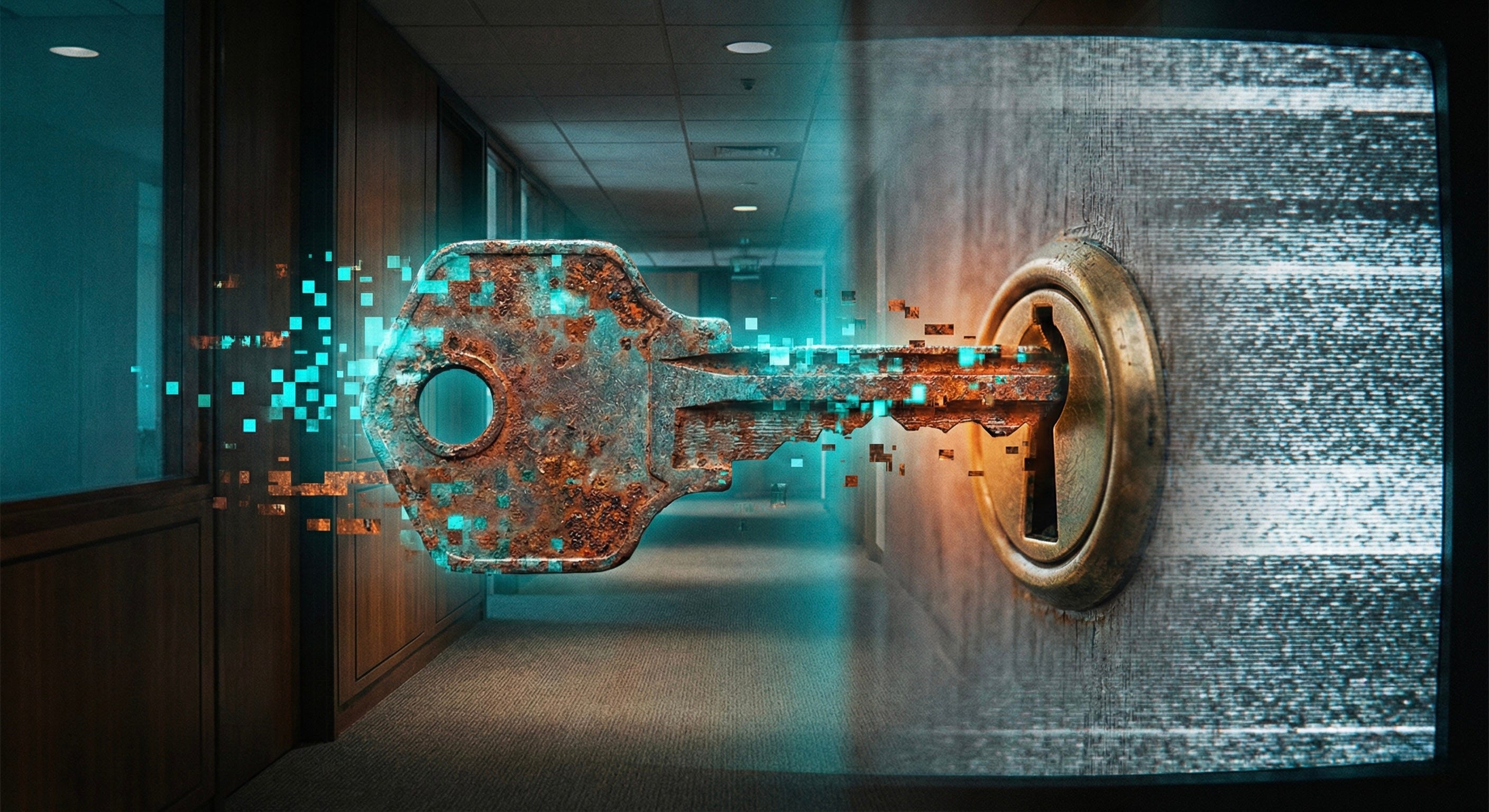
The house was always quiet at 3:30 PM.
If you were born between 1965 and 1980, you know this silence. You know the weight of the key around your neck. You know the rule: lock the door, do your homework, don’t answer the phone. We were the Latchkey Generation, the first feral children of the modern age. We learned to survive without supervision. We learned that if our parents couldn’t see us, we were safe... but we were also alone.
Fast forward to 2026.
That feral kid is now the CEO. The latchkey is now a keycard. And suddenly, the generation that invented the VPN, the chat room, and the remote server is demanding everyone get back in the building.
It is the great irony of the 2020s: The architects of remote work have become its jailers.
This isn’t about productivity. The data has been clear since 2020. This is about trauma. We are charging our employees a “Presence Tax” to assuage our own anxiety. We are trying to fill the empty house.
The Acoustic Failure: The “Irrelevant Speech” Effect
Let’s look at the actual environment we are forcing people back into.
In 2026, the modern office is an open-plan acoustic disaster. We stripped away the cubicle walls in the 2010s to foster “collision” and “collaboration.” What we actually created was a cognitive minefield.
Acoustic researchers call it the “Irrelevant Speech Effect” (ISE).
It isn’t just noise. If a fan is humming, your brain can tune it out. But if a human voice is speaking intelligible words nearby, your brain cannot ignore it. It is a biological hardwire. Your processing power is hijacked to decode the syntax of your neighbor’s sales call.
Studies show that ISE increases cognitive load and spikes physiological stress. We are mandating that knowledge workers… people paid to think deeply… return to an environment where deep thought is biologically impossible.
We demand “focus” while placing them in a room designed for distraction.
The Glass Cage Fallacy
Oh, and now some offices try to fix this by giving everyone an office. It seems like the logical retreat. If the open plan is hell, the private room must be heaven.
Science disagrees.
First, there is the "Allen Curve." Decades of research prove that communication frequency drops exponentially with physical barriers. When you box people in, you kill the "weak ties," those random interactions that actually spark innovation. You trade distraction for isolation. Here is the kicker: we actually solved this remotely. We didn't need a water cooler to have random collisions; we built them digitally. We sparked innovation in Slack channels and impromptu Zoom huddles without smelling each other's microwaved fish. We proved that "weak ties" travel just fine over fiber optics.
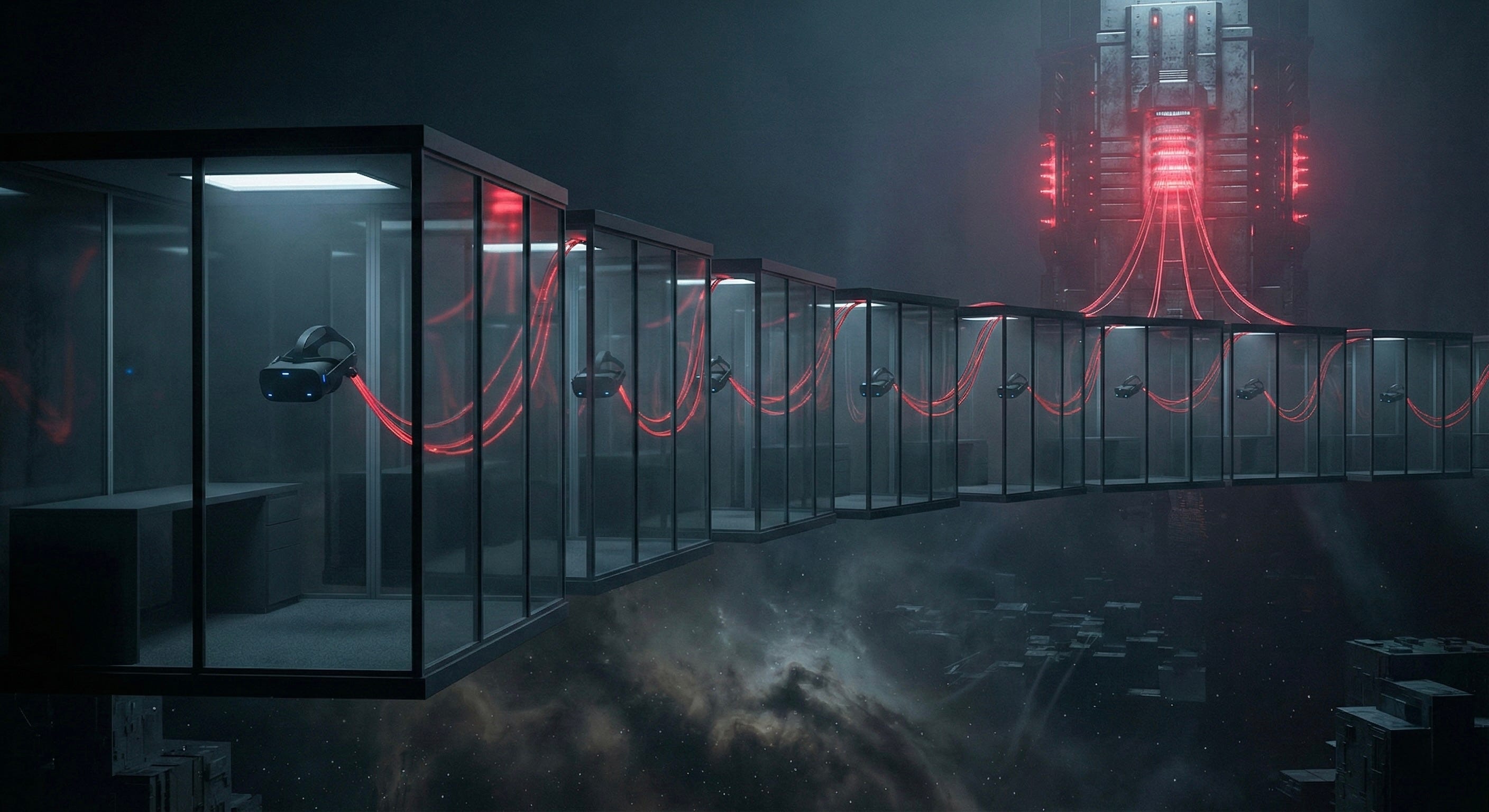
Second, the modern “private” office is rarely private. It is a glass box. You trade acoustic noise for visual surveillance. Psychologically, this is known as the “Fishbowl Effect.” You are still on stage. You are still performing. You just have a mute button.
You cannot build a better office than the one the employee already built at home.
The Caregiving Blind Spot: Severing the “Being”
The friction goes deeper than walls or windows. It hits the wallet, and it hits the soul.
During the remote years, workers built intricate, fragile ecosystems of care. They balanced jobs with toddlers, aging parents, and pets without outsourcing every single interaction. They wove work into life.
The RTO mandate tears this fabric apart.
Childcare: The average cost of daycare has skyrocketed. Mandating a return to the office forces parents to pay for “commute coverage”--hours they used to cover themselves.
Eldercare: 61% of caregivers are also full-time employees. Being remote allowed them to check on a parent at lunch. Being in the office means hiring a nurse.
Pet Care: It sounds trivial until you look at the data. Caring for a dog over its lifetime now costs between $20,000 and $60,000.
Leadership acts as if these costs are invisible. They aren’t. They are a pay cut.
But the deficit isn’t just financial; it is existential. We are effectively severing the “Being” from the “Human.”
Consider our history. For 200,000 years, whether we were nomadic wanderers or settled tribes, “work” and “life” were not geographically divorced. We hunted, gathered, and built alongside our kin. We were there for the elders. We were there for the young. This integration is encoded in our DNA. We are tribal creatures, designed to exist within the hum of our community.
The modern office mandate is a recent, artificial aberration that splits this atom. It demands we abandon our tribe to sit in a glass box, disrupting the oldest social contract we have: the promise to be present for each other. We are trading our biological heritage for a commute, driven not by necessity, but by a leadership class paralyzed by fear and unable to trust what they cannot see.
The “Microsoft Effect” and the Sheep Strategy
So why are we doing this?
If the acoustics are bad, the private offices are isolating, and the human toll is heavy, why the push?
Because we are mimics.
Look at Microsoft. They set the tone. They announce a “hybrid” policy that is effectively a soft mandate. They are the visible giant. And what happens next is a failure of independent thought that ripples down the entire economy.
Smaller companies… startups, mid-sized agencies… look at Microsoft (or Amazon, or Google) and think, “Well, that must be how you run a serious company.”
It is a cargo cult mentality.
Leadership at these smaller firms lacks the courage to think for themselves. They don’t look at their specific workforce, their specific culture, or their specific data. They just copy the homework of the class giant, terrified that if they don’t, they aren’t “real” executives.
We are sleepwalking into a 2019 model in a 2026 world, dragging our employees back into the noise, away from their families, for no reason other than we are too afraid to lead with our eyes open.
Resources
Microsoft Work Trend Index: Hybrid Work is Just Work - The definitive industry report identifying “Productivity Paranoia”--where 87% of employees report high productivity, but only 12% of leaders have confidence in it.
Gallup: State of the Global Workplace 2025 - Global data confirming that fully remote workers report the highest levels of engagement (31%) compared to on-site workers (19%), debunking the myth that presence equals commitment.
Irrelevant Speech Effect in Open Plan Offices - Scientific validation that intelligible human speech (not just noise) is the primary destroyer of cognitive performance in open-plan environments.
Harvard Business School: Hidden Workers & The Care Economy - A comprehensive report detailing how businesses lose billions by ignoring the “Care Economy” (children and elders), forcing employees to choose between work and family.
Is the Allen Curve Still True? (Cornell/MIT Analysis) - An analysis of Thomas Allen’s famous “proximity” theory, updated to show that while distance matters, digital tools have successfully bridged the gap for “weak ties” in modern teams.
Synchrony: The Lifetime Cost of Pet Ownership (2025) - New data showing the lifetime cost of a dog has risen to over $60,000, making the “commute cost” for pet care a significant financial hit for workers.
PNAS: Work Time and Market Integration in Tribal Societies - Anthropological evidence supporting the argument that for 99% of human history, “work” and “family life” were integrated geographically, not separated.
Visier: The Truth About Productivity Theater - Data revealing that 43% of employees spend more than 10 hours a week on “performative work” (looking busy) just to satisfy visual management styles.