

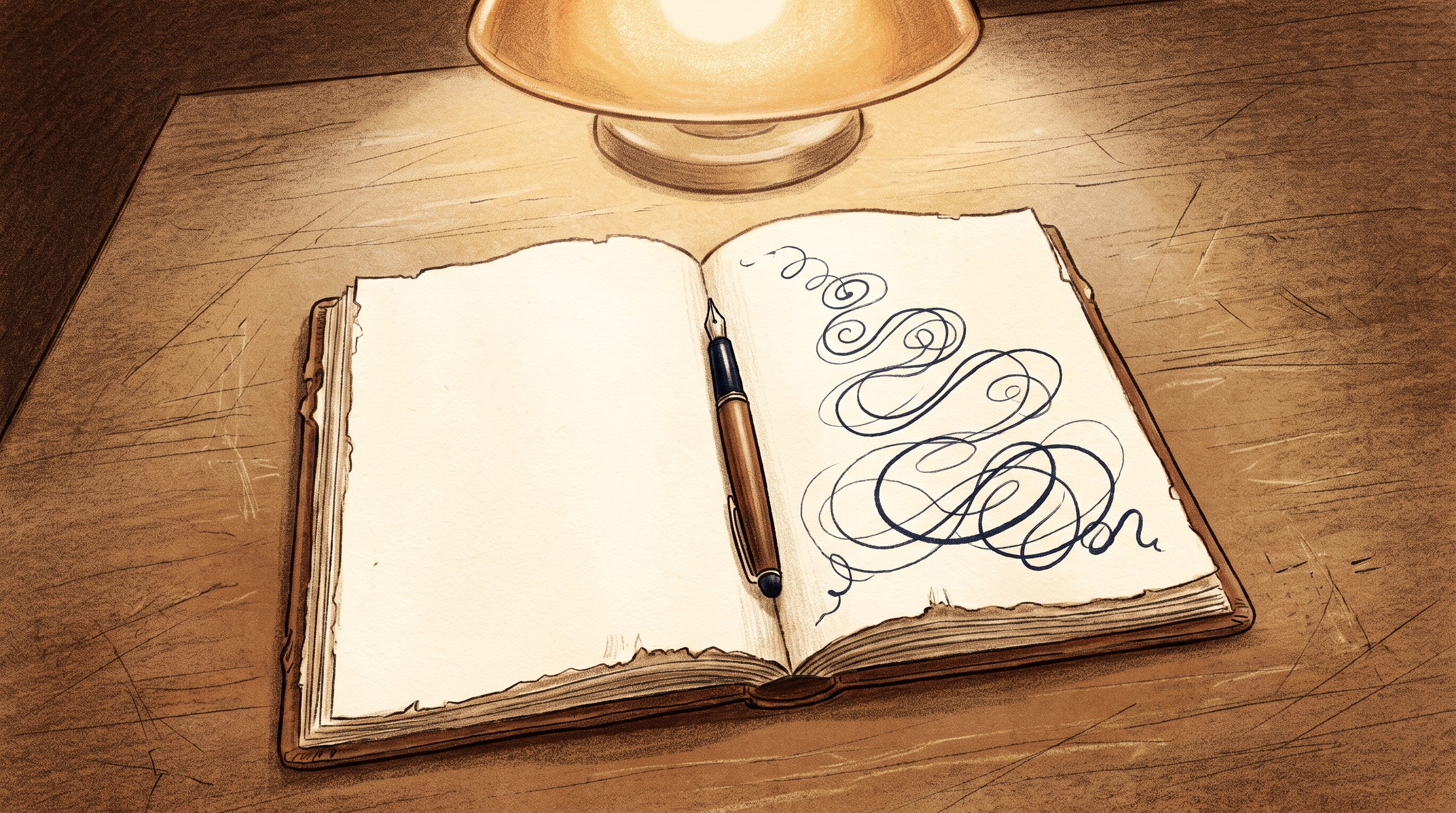
I keep a paper notebook on my work desk, and most of what’s in it is unreadable. Not encrypted. Just bad handwriting, getting worse toward the bottom of each page, where I was thinking faster than my hand could keep up (which is most of the time). I’ve kept one for years without thinking much about why.
This year the question got sharper. There’s a model on this same desk that will write me a clean, confident paragraph about anything I ask, in perfect grammar, in about two seconds. So why do I still reach for the pen. This is me working that out.
The slow channel
Handwriting is a bad way to move words. That’s not an insult, it’s a spec. Measured as raw data transfer, the hand is one of the slowest output channels a person owns. Most people type at roughly two to three times the speed they can write legibly, and you can prompt a model faster than that. By every metric a systems person is trained to optimize, the pen loses.
I’ve spent a lot of words in this publication arguing that friction is a vulnerability. In operational systems it is. Every extra click, every permission loop, is a place where tired people invent unsafe shortcuts. I still believe that. The notebook is where I keep the exception, because at the desk the friction is doing the opposite job.
The hand is slow enough that you can’t transcribe. You have to choose. When the channel is that narrow, you can’t push everything through it, so you’re forced to decide what matters before it reaches the page. That deciding is the thinking. Typing lets you keep pace with a meeting, which sounds like an advantage right up until you notice you captured the whole thing and processed none of it. The keyboard is fast enough to route around the part of you that was supposed to understand.
What the research actually says, and doesn’t
I want to be careful here, because this is exactly where people oversell.
The famous study is Mueller and Oppenheimer, 2014, “The Pen Is Mightier Than the Keyboard.” Students who took lecture notes by hand wrote fewer words and scored better on conceptual questions than the ones typing near-verbatim. It got repeated everywhere. The honest footnote, the one that rarely travels with the headline, is that the strongest version hasn’t reliably replicated. Later work often couldn’t reproduce the conceptual edge. So I don’t lean on it as proof. I lean on the part that has held up: longhand writers summarize instead of transcribe, and summarizing is a different act than copying.
There’s a newer, stranger piece of evidence. In 2024 a group in Norway ran high-density EEG on students while they wrote words by hand versus typed them. Handwriting produced broad connectivity across the brain, different regions talking to each other. Typing mostly didn’t. It’s a small study, single words with a stylus on a screen, not a verdict on note-taking, and I’d be embarrassed to wave it around as one. But it points the same way the felt sense does: the hand recruits more of you.
Neither result tells you to throw out the keyboard. I’m typing this. What they sketch is a mechanism, not a commandment: the slow channel makes you encode instead of capture.
The year the machine started writing
Two things shifted at the same time, and the second one changed what I thought about the first.
For most of my life, producing text was the work. Getting words out of your head and into legible order took effort, and the effort was doing something to your thinking on the way through. That is over as a default condition. There’s a model on this machine that will produce fluent, structured, sure-footed prose about anything, instantly, and well enough that you can ship it without understanding a line of it. Producing text is no longer evidence that anyone thought.
I don’t say that as a complaint about the tool. I use it every day for certain tasks and it’s genuinely good. But it changes what the pen is for. The technical term researchers use is cognitive offloading: when a tool takes over a mental task, the brain stops practicing it. When text is free and infinite, the value was never really in the text. It was in the thinking the old friction used to force, and the model cheerfully removes the friction, which means it quietly removes the thinking too, unless you go do that part somewhere else on purpose (which I strongly encourage.)
What the hand keeps
So the notebook isn’t a productivity system. It produces almost nothing anyone else will read. It’s terrible storage. I lose things in it constantly, and the search function is just me, trying to remember the shape a thought made on a page. By every standard I’d apply to a tool at work, it fails.
What it keeps was never the words. It’s the residue of having had to choose them slowly, and that residue is the one thing a faster channel can’t hand back to me. The pages I can’t read are pages I still remember writing. I remember what I decided while my hand was busy, which is more than I can say for most of what I’ve typed at full speed, and all of what I’ve asked a machine to draft.
I don’t think everyone needs a notebook. I think everyone needs one channel the machine can’t do the thinking in for them. The pen isn’t mightier than the keyboard. It’s just slower than I can lie to myself, and this year that turned out to be the feature I couldn’t get anywhere else.